Every gutter hand-cleared, every downspout flushed, every joint checked, on the wettest, most tree-covered lots on the North Shore.
Under Environment and Climate Change Canada’s 1981–2010 Canadian Climate Normals, the North Vancouver Wharves station records 1,724.8 mm of precipitation a year across 181 days with measurable precipitation, and the Sonora Drive station further up the slope normals out at 2,355.6 mm. Vancouver International Airport, for comparison, sits at 1,189.0 mm. West Vancouver is on the same rain-catching mountain face, and every millimetre that lands on your roof has to leave through a gutter.
The other half of the problem is what falls into that gutter. Western red cedar, Douglas fir and western hemlock shed needles and cone scale steadily through the year rather than in one tidy autumn drop, and needles are the worst possible debris: they slip past most guards, mat together, and pack solid at the downspout outlet. Add moss growing on the roof edge above and a gutter can be blocked in July even though nothing looks wrong from the driveway.
When a gutter overflows on a West Vancouver lot it does not just make a mess. It dumps concentrated water at the foundation, saturates the ground above retaining walls, rots fascia behind the gutter line and ices up in a cold snap. The repair is always more expensive than the cleaning.
Get a free estimate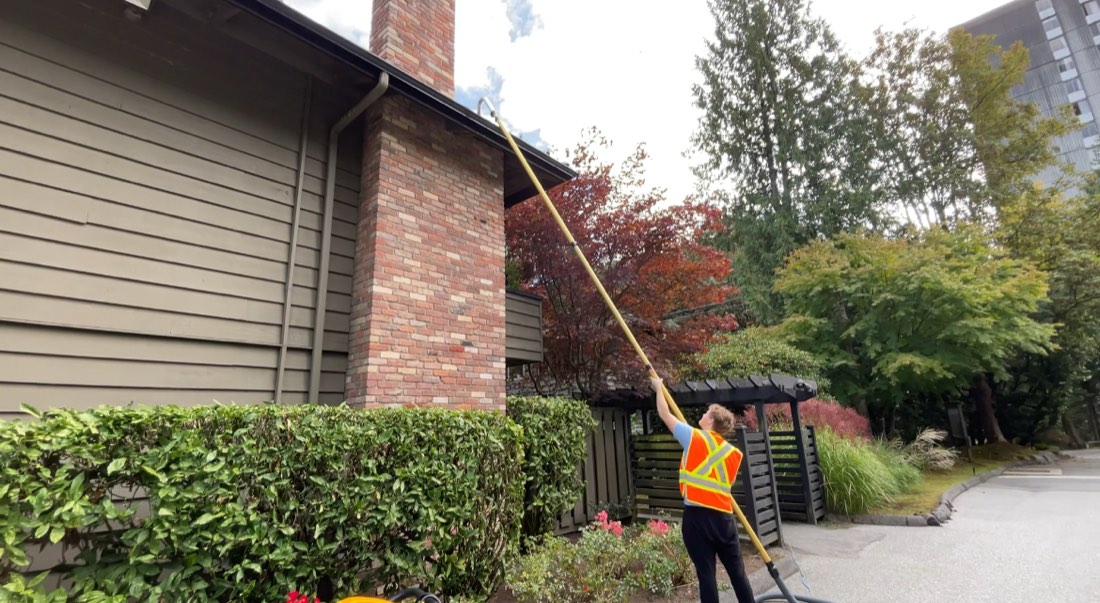
West Vancouver homes back onto forest more often than not. The provincial FireSmart BC Begins At Home guide is direct about the roofline: “Regularly remove debris from gutters, since embers can easily ignite dry materials,” and “clean your roof regularly of combustible materials such as leaves and branches.”
That guidance sits in the Immediate Zone, the 0–1.5 metre band closest to the house, which FireSmart treats as the highest-priority area of the Home Ignition Zone. The zones then step out to Intermediate at 1.5–10 metres and Extended at 10–30 metres. A gutter packed with dry needles is a continuous line of fine fuel running along the top of your Immediate Zone, which is exactly the kind of thing a wind-driven ember is looking for.
So the late-summer clean matters as much as the pre-winter one, and for a different reason. We are happy to time your cleans around both: dry fuel out before wildfire season, leaf and needle load out before the heavy autumn rain arrives.
Get a free estimateBlowing the top layer out and driving away is not a gutter clean. Here is the full sequence we run on every West Vancouver property.
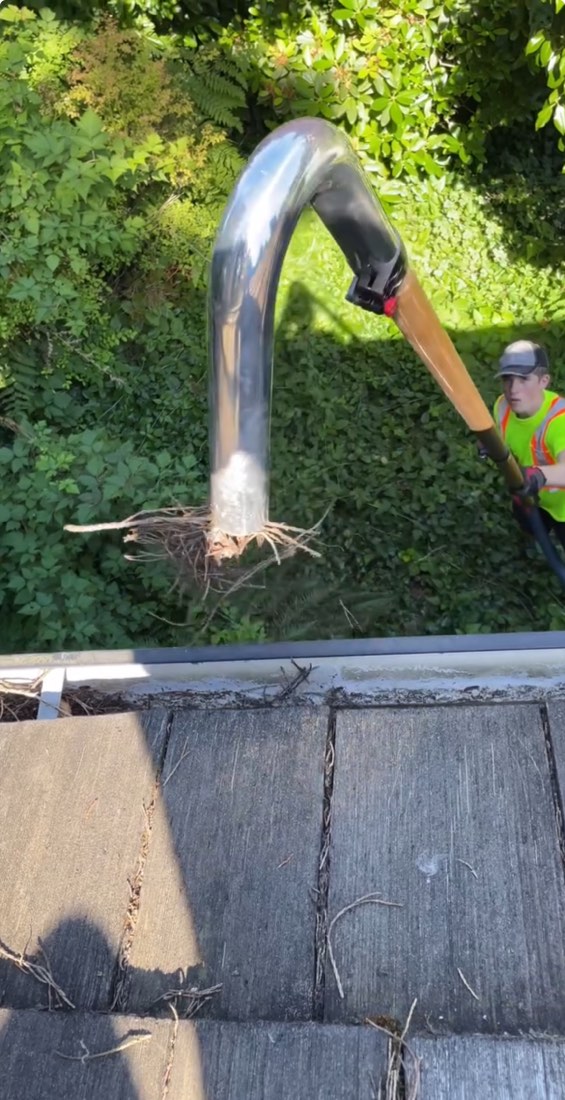
Every run is cleared by hand or vacuum down to the base of the trough, including the packed compost layer under the loose needles, and the debris leaves with us.
We flush each downspout and confirm water is actually discharging at the bottom. A clear gutter feeding a blocked downspout still overflows.
We pull moss, needle mats and branch litter off the roof edge and out of the valleys above the gutter line, so it does not wash straight back in with the next storm.
We look for separated joints, sagging runs, loose spikes and rotted fascia while we are up there, and photograph anything you should know about before it becomes a repair.
Based at 345 Kelvin Grove Way in Lions Bay and working West Vancouver and the North Shore year-round.
Twice a year is the sensible baseline here: once in late summer or early autumn, and again after the leaves and needles have finished falling. Properties surrounded by mature conifers often need a third visit, because cedar, fir and hemlock shed year-round rather than in a single autumn drop. We will tell you which camp your property is in after the first clean.
Yes, and there is a real argument for it. Wet debris comes out of the trough more easily than a dry, cement-hard mat, and heavy rain is the best possible test that a downspout is genuinely flowing. Safety comes first, so we will reschedule for high wind or ice.
No. Gutter cleaning is mostly debris removal, and the flush we run to prove a downspout is small. Metro Vancouver’s Drinking Water Conservation Plan restricts lawn watering and the washing of impermeable surfaces such as driveways and siding from Stage 2 onward. If your job also involves washing a surface, we check the stage in effect first and explain how it applies.
Yes. Everything we pull out of the trough and off the roof edge leaves with us. We do not bag it and leave it beside your bins.
Usually yes. Steep, tall and awkward-access properties are normal in West Vancouver. Send us the address and a photo of the worst side and we will confirm before we quote rather than after we arrive.
In the West Vancouver market gutter cleaning is typically priced on linear footage of gutter, the number of storeys, roof pitch and how hard the property is to access, and a heavily overgrown first clean usually costs more than the maintenance visits after it. Call 236-984-0598 for a real, no-obligation number for your address.
Send us your address and roughly how long it has been. We will come back with a clear, no-obligation quote, usually within one business day.